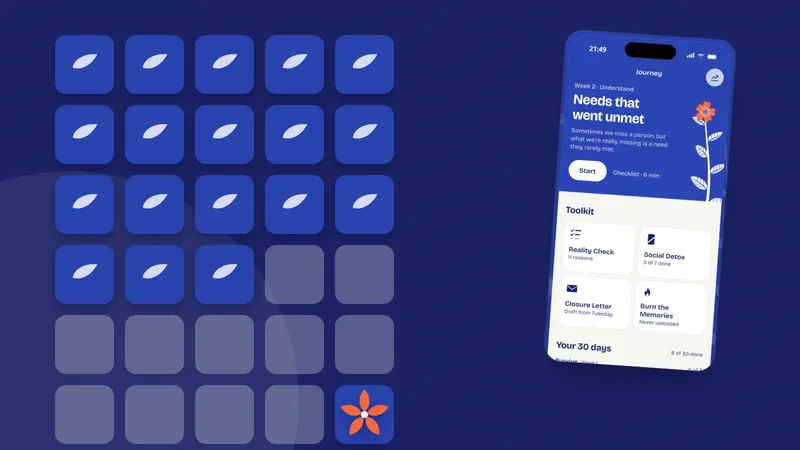

To get over a breakup, stop the contact that keeps the wound open (No Contact), look after the basics (sleep, food, movement, people), let yourself grieve instead of rushing, and slowly rebuild a life that is yours: routines, friends and things you enjoy. Most people feel clearly better within a few months, with good and bad days along the way.
The short version
- Feeling awful is normal. Rejection activates some of the same brain systems as physical pain.
- The single biggest lever is distance: stop checking, stop texting, stop waiting.
- Recovery is not a straight line. A bad day does not erase a good week.
- Small daily actions beat big gestures. One short task a day adds up.
First, why it hurts this much
If a breakup feels physical, that is because in some ways it is. In one study, people who looked at a photo of an ex who had recently rejected them showed brain activity in regions that also process physical pain. Other research found that thinking about a rejecting partner engages reward and craving systems. Put simply: you are grieving and in withdrawal at the same time.
That is why advice like "just stop thinking about them" does not work. You cannot think your way out of withdrawal. You get through it, day by day, by not feeding it and by giving your mind other things to hold on to.
The first 72 hours
The first days are about getting through, not getting over. Lower the bar on purpose:
- Eat something simple, drink water, and try to sleep at roughly normal times.
- Tell one or two people what happened. You do not have to explain everything.
- Mute or unfollow your ex, and archive the chat. You can decide about the rest later.
- Let yourself cry. Holding it in tends to make it come out sideways.
- Skip big decisions: moving, quitting, dramatic haircuts. Not this week.
Weeks 1 to 4: create distance and structure
This is where the No Contact rule does most of its work. Every day you do not check or reach out, the craving loses a little power. Alongside that, build a simple daily structure, because grief loves empty time:
Morning anchor
One small thing every morning that is just for you: a walk, a shower with music, coffee somewhere else.
Move a little
Ten to twenty minutes of walking or any movement helps sleep and mood. It does not need to be a workout.
One person a day
A message, a call, a coffee. Isolation makes everything louder.
Write it out
A few lines each night. Research on expressive writing suggests that putting difficult feelings into words can help people make sense of them.
Count the days
Track your No Contact days. Seeing the number grow is quietly powerful.
Months 1 to 3: understand and rediscover
As the sharpest pain eases, you get room to think. This is a good time to look honestly at the relationship, not to blame yourself or them, but to understand. What did you need that you did not get? What would you do differently? What were the red flags you talked yourself out of?
It is also the time to rediscover the parts of you that got smaller: friends you saw less, hobbies you dropped, places you stopped going. Start with one.
What helps, and what usually does not
| Usually helps | Usually keeps you stuck |
|---|---|
| No Contact and muting their accounts | Checking their profile "just once" |
| Sleep, food, daylight and movement | Drinking to sleep or to forget |
| Talking to people who are on your side | Asking mutual friends for updates on them |
| Writing what you would say to them | Sending what you would say to them |
| Small routines and plans for the week | Waiting at home for a message |
| Letting yourself grieve | Jumping straight into a rebound to avoid it |
How long it takes to get over a breakup
There is no fixed timeline, and anyone who promises one is guessing. It depends on how long you were together, how it ended, whether you have to stay in contact, and what else is going on in your life. Many people notice they feel clearly better within a few months, and that the gaps between bad days get longer. Our guide to the stages of a breakup explains what to expect along the way.
Signs you are getting over it
- You go hours, then days, without checking their profile.
- You can remember the good parts without it hurting as much.
- You make plans that have nothing to do with them.
- Their name comes up and the conversation moves on.
- You catch yourself looking forward to something.
When to get more help
A breakup is painful, but if weeks pass and you cannot sleep, eat or function, or you feel hopeless, please talk to a doctor or a mental health professional. That is not a failure. It is the right tool for a heavier load.
Questions people ask
How long does it take to get over a breakup?
It varies a lot. Many people feel noticeably better within a few months, and longer relationships often take longer. What matters more than the calendar is the trend: bad days becoming less frequent and less intense.
How do I stop thinking about my ex?
You cannot switch thoughts off, but you can stop feeding them. Cut the reminders (No Contact, muting, putting photos away), fill empty time with people and routines, and when a thought comes, notice it and let it pass rather than arguing with it.
Is it normal to still love my ex?
Yes. Love does not switch off when a relationship ends. You can still love someone and know that the relationship was not right for you. Feelings fade with time and distance.
Should I stay friends with my ex?
Maybe one day, but rarely straight away. Friendship right after a breakup tends to keep hope alive. Give yourself a long stretch of No Contact first, then decide from a steadier place.
Sources
- Kross, E. et al. (2011). Social rejection shares somatosensory representations with physical pain. PNAS, 108(15), 6270–6275.
- Fisher, H. E. et al. (2010). Reward, addiction, and emotion regulation systems associated with rejection in love. Journal of Neurophysiology, 104(1), 51–60.
- Pennebaker, J. W. (1997). Writing about emotional experiences as a therapeutic process. Psychological Science, 8(3), 162–166.
- Find a Helpline: free, confidential support in more than 130 countries
This guide is general information, not therapy or medical advice.